Monday, April 10, 2017

The Macclesfield Psalter and a Good Boy at Pennsic

Macclesfield Psalter; script, justification, and compositional format
^^ Pdf link ^^


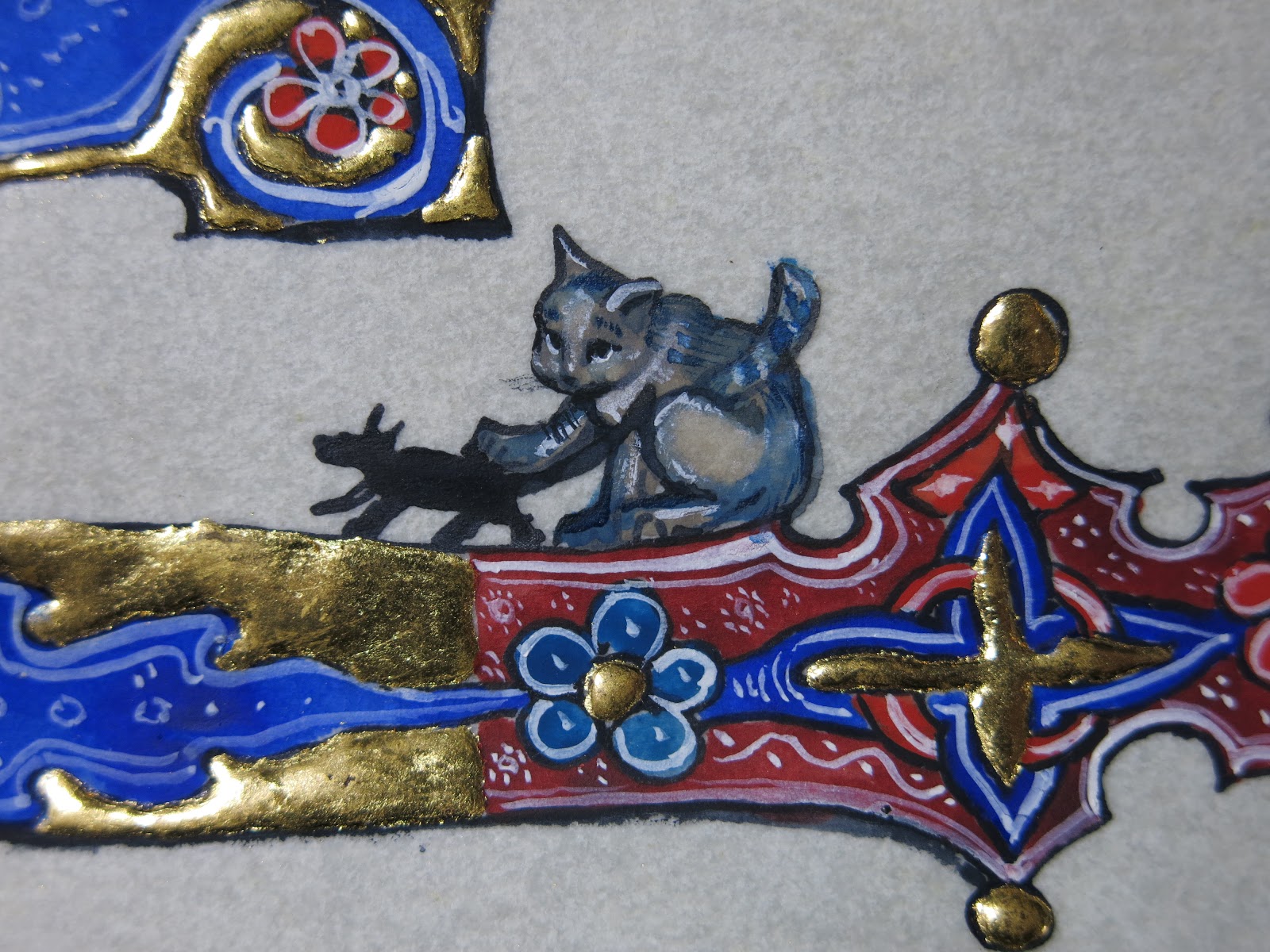
Last year at Pennsic, my family attended Baronial court, and our lovely and wise and very funny Baroness was finally able to catch up with me on scrolls and awards that I have tripped through my SCA career accumulating, but never actually physically obtaining because I never seem to make it to court.  My beautiful boy was well and truly asleep in his wagon (so I thought), but after a hilarious call-back and a new award that made me tear up a bit, my son announced that he too needed a scroll for being such a good boy, and it ought to have three cats, a blue one, a red one, and a white one.  Now this may seem a bit cheeky, but he was two closing in on three, and he was indeed a very Good Boy at Pennsic, and while it wasn't Silver Buccle level awesome kid stuff, I did think he deserved an award from his very tired parents for how wonderful he was. 

Dyryck Hastings did the wording for me as I was stumped, and then several more months went by with me pushing this project aside for official Kingdom assignments, and finally I finished it in time for the Pentathalon at The Festival of the Passing of the Ice Dragon in Buffalo, NY (Hamburg Fairgrounds, great site for this event).


I took my time, my son helped - including tossing a whole lot of real gold all over the floor & in dirty paint water that he had set right on the scroll, and dumped the entire bottle of gold dust in said water... oh dear... but it all turned out OK in the end and we all learned Very Important Things; me to put my gilding materials away every single time I leave my desk, and him not to touch gilding without assistance from Mamma.  I got a great deal on patent gold, he got his own special scribal supply box.  He helped gild for real, carefully following instructions (press here), and even got to paint some of the blue, so he has a hand in his own award.

This was also an opportunity for me to keep some of the artwork I make.  While it is his, I can borrow it back for shows, classes and demos.  This was the first format that I have made adjustments to based on key compositional elements.  While the overall composition is very similar to the original folios, I'm starting to get a good feel for when things ought to shift, and what motifs are used when.

The write-up is only three elements of the Macclesfield Psalter, and there is a lot more to explore.  I'm trying to develop a track of classes on this manuscript, and this format is helping me sift through what is important. I hope you enjoy the pdf. if there are any issues please let me know, hopefully I'll be able to get to comments, I've been locked out of my e-mail for a while.  If you can't get me there, look me up on FB and I do check my 'other' box.


Three little cats
Sitting in a row
Who will get the mouse?
No one can know.

Friday, February 24, 2017

Painted Boxes and AEthelmearc Artisan's Exchange


Or "that time you thought you had the documentation done but then remembered that the entries called for 'short form' doc and it was handwritten and is now lost in the piles of paperwork in that cardboard box upstairs."  Gaah!  I have two goals for this year: better displays and better documentation. 
_________________________________________
Last year I participated in the AEthelmearc Artisan's Exchange, which was lovely.  I've done two so far and I think it's a great experience that can open up your range of skills and interests, and it's also like being Santa except you get a gift too.  It's the perfect amount of socialization for introverts.  Odkatla has it set up as a random white elephant exchange, so you may or may not know the person you are making something for.  In this case, I knew Anna Leigh from FB, though I missed all but one of her courts while she was queen.

Here is the finished gift as I gave it to her, below is the original inspiration box which is inlaid wood on the outside and painted on the inside.
Dear Anna Leigh,

There are two confections in this box; one is ‘medieval gingerbread’ which my son affectionately calls ‘ginger meatballs,’ the other is marshmallow fondant roses.  The gingerbread is a honey & bread candy with spices which tastes much better than it looks.  I could not resist making the fondant as they were so pretty.  I will try this with a more period appropriate recipe at a later date, but so far everyone loves it; I can eat about ½ a rose at a time.  Please take the candy out of the box so the paper doesn’t stick. 

The box is based on a 1325-1350 German box housed in the Met #DP273975.  I took some liberties with the outer design, but maintained the inside concept, just replaced the heraldry and details to follow your own arms and awards.  It is egg tempera, and will take 3 months to cure.  Once it is cured, it should be very durable and you can carry it around without smudging, prior to that it should not be handled much.  Set it in a sunny window and rotate the sides for about 2 weeks.  That will help it dry evenly and the yolk will harden nicely.  It will also help clear up any yellowing.

I hope you love everything as much as I loved making it!
YIS,
Abigail Kelhoge

Medieval Gingerbread:
wildflower honey, saffron, cinnamon, white pepper, ginger, bread 1 (enriched wheat flour, malted barley flour, reduced iron, niacin, thiamin mononitrate, riboflavin, folic acid, water, HFCS, yeast, soybean oil, wheat gluten, salt, monoglycerides, calcium propionate, calcium slufate, datem, grain vinegar, citric acid, potassium iodate, soy lecithin), bread 2 (whole wheat flour, water, yeast, salt, sugar, vegetable shortening).

Fondant roses:
powdered sugar, sugar, corn starch, (marshmallows) corn syrup, sugar, corn starch, gelatin, blue 1, food coloring, water.


From the Met
Coffret (Minnekästchen)
Date: ca. 1325–50
Geography: Made in Upper Rhineland, Germany
Culture: German
Medium: Oak, inlay, and tempera; wrought-iron mounts
Dimensions: Overall: 4 3/4 x 10 3/4 x 6 1/2in. (12.1 x 27.3 x 16.5cm)
Classification: Woodwork-Furniture
Credit Line: Rogers Fund and The Cloisters Collection, by exchange, 1950
Accession Number: 50.141
The inside of this coffret's lid depicts Frau Minne, the German goddess of love, aiming and arrow at a young man. At right, he gives her his heart. The inscriptions have been interpreted as: "Gracious lady, I have surrendered," and "Lady send me solace, my heart has been wounded." The coffret embodies the notions of courtly love, a concept that developed during the feudal period and imagined romance as playful warfare between the suitor and beloved. The arms on the box may be those of the Berstett family of Alsace, Baden, and Austria.

Thursday, February 23, 2017

Viking Jorvik Bone Pins or Long Time No Post

Hiya!  Long time no post.  I've been distracted by motherhood.  My kid is awesome and cute and busy and I'm OMG tired, so when I'm not making stuff for the SCA or racing around after the kid or changing fish tank water, or being mesmerized by the little swimming things, or brushing fuzzy bunnies, I'm totally not blogging.  Zoning out on FB, but not blogging.  So I may be back to blogging.  This post will be my test run on how well Blogger handles photos & such (now). 
Edit: woo-hoo!  drag & drop is back!  I may be blogging again!
________________________________________________

Fig 1.  Decorative bone pins found at Coppergate
My unfinished reproduction of the 2nd from left.

Decorative bone pins may have been used to fasten dress straps, veils, cloaks or other woven items; or as hair pins, though these are a little short for that. Many bone pins found in Viking Jorvik[1] have a large hole in the decorative head, for a cord to loop around and hold everything in place.  Archeologists assume these pins were worn in pairs, but they are usually found alone, likely because they are easily lost (fig 2).  Most of the pins found in Jorvik were made from pig fibula.  Tools from the Coppergate dig site included a fine-toothed saw, files, and knives. No bone pins have been found in a grave, but most archeologists assume their function was similar to the metal ring broaches, which also have a decorative head with a hole, a ring and a chain to hold material, and have been found in a woman’s grave at either shoulder, presumably holding a cloak or dress in place, (McGregor, 1982, fig 2. /  Fig 3). Carved bone pins may have been worn in place of the metal broaches for less formal occasions.
It is difficult to date decorative bone pins as there are no distinct style trends aside from broad Roman, Viking, and Medieval era aesthetics, and even that is difficult – each pair seems to have been unique.  Radiocarbon Dating (RCD) is relatively accurate, but a portion of the material must be destroyed, and funding is rarely available making it impractical.  Pins are best dated according to deposition layers, giving us the approximate date of last use. 
Fig 2. Lloyds Bank excavation, McGregor 1982

Fig 4.  Lloyds Bank excavation, McGregor 1982
Shows copper and bone pins in various states of finish - all discards. 

Fig: 3. (murdering spelling), Dunphiers?
copper decorative pin

Fig. 5.  Pair of bone pins.
This pair of bone pins is modeled after the 2nd from the left (fig 1).  I guessed at the size based on shaft thickness and proportion, and the possible length of usable bone being a maximum of 7” from a large sow, with most usable space averaging 4”.  The fibula is strong and has a long smooth shaft that tapers from one end to the other, making a natural transition between head and point easier.  The bone was boiled and debrided, then allowed to dry for several weeks (months).  I cut the ends off and then sawed the bone in half for ease of handling.  Removing the bone matrix inside was annoying but not difficult, a chisel worked best.  I made the first pins by marking out the design on the bone, carving the lines deeper, and gently hammering out the remainder when it got close.  Cutting with a knife took a long time, but thankfully a fine blade saw was found in the Coppergate dig, so I felt free to use faster tools – both of these pins were cut with a saw.  I filed the pins into shape, and down to size, and then drilled the holes.  Many pins and other bone tools have some of the marrow matrix left on the back, so I left that as well, though it looks odd and unfinished to modern eyes.
So far, I have gotten over 15 items from one bone and there is more material to cut.  The bone is easy to work using both knives and a saw.  The main precaution is not inhaling the dust as that can be hazardous.
1st pins tucked in cloth with very messy cords.
The cords are 5 strand fingerloop braids (not pictured), the actual configuration and knots used in the originals are unknown.  This is where experimental archeology has to take over until or unless a major find with bone pins in situ comes to light.  


[1] Viking age Jorvik refers to the city of York, England from 866-1066.  It has been continuously inhabited from 8,000 BCE.  In 71 CE the Romans ‘founded’ the city as Eboracum, then the capitol of Northumbria, then Jorvik and it finally became York in 1068 when William the Conqueror laid waste to the city and installed Norman rulers.

Bibliography:

Historiska
(purse, thread holder, needle) (relates to other items in this project)
http://translate.google.com/translate?hl=en&langpair=sv|en&u=http://mis.historiska.se/mis/sok/bild.asp?uid=28686

Viking Jorvik Center Gallery
(bone pins)  Seriously check out this site, they are amazing!
http://jorvik-viking-centre.co.uk/about-jorvik/gallery/

Medieval Garments Reconstructed: Norse Clothing Patterns
(fingerloop braiding & yarn)

Hair care info
(hairstyles/pins)
http://www.vikinganswerlady.com/hairstyl.shtml


Anglo-Scandinavian Finds from Lloyds Bank, Pavement and Other Sites. 
Arthur McGregor, 1982.  (free pdf)York Archeological Trust For Excavation and Research

History of York, England
https://en.wikipedia.org/wiki/York